Bugatti Veyron

Chevrolet Camaro

Shelby Aero Ev
Mercedes-Benz

Saturday, June 12, 2010

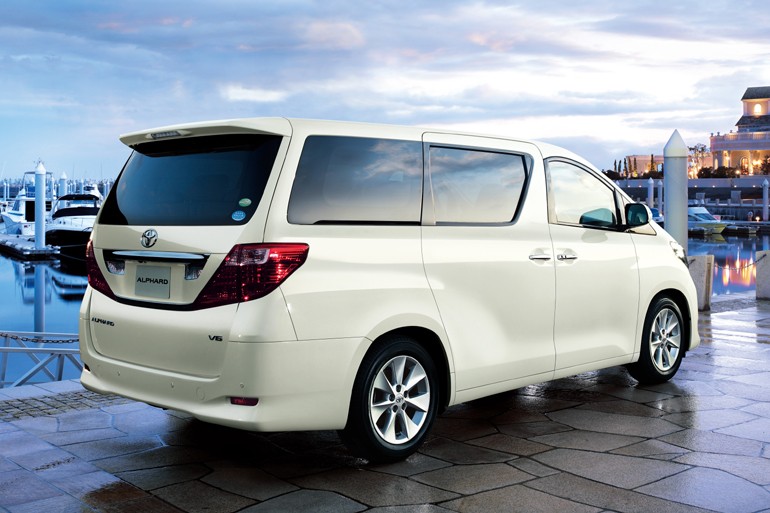
Review Toyota Alphard | Specification


Toyota Alphard Specification:
Engine
Engine Type: 2GR-FE, V6, 24-valve DOHC, Dual VVT-i
Bore x Stroke mm: 94.0 x 83.0
Displacement cc: 3.456
Compression Ratio: 10.8: 1
Maximum Horse Power Ps / rpm: 275/6200
Maximum Torque kgm / rpm: 34.7/4700
Fuel System: EFI
L Fuel Tank Capacity: 65

Dimension
Height Wheelbase | mm: 2.950
Rear Tread | mm: 1.585
Ground Clearance | mm: 160
Curb Weight | Kg: 2.055
Overall Length | mm: 4.850
Overall Width | mm: 1.830
Overall Height | mm: 1.890
Tread Front | mm: 1.580

Chassis
Transmission Type: 6 Speed A / T Sequential
Gear Ratio 1st: 3300
Gear Ratio 2nd: 1900
Gear Ratio 3rd: 1420
Gear Ratio 4th: 1000
Final Ratio: 3684
Front Suspension Type: MacPherson Strut
Rear Suspension Type: torsion beam
Front Brake System: Ventilated Disc
Brake System Rear: Solid Disc
Tyre Size: 215/65/R16
5th Gear Ratio: 0713
Basic Frame: Monoqoque
Steering Gear: Rack and Pinion
Wheel Cap: w / Center Ornament
Additional Brake System: ABS, EBD, BA, VSC, TRC
Reverse Gear Ratio: 4148
6th Gear Ratio: 0608

Review Toyota Alphard:

Queens Magical place to find quality time with their king. Wonderous mysteries which collided with a smile in their sleep a thousand miles from a sweet kiss. Where children are adventurous, who can not sit in one place, have the freedom to fly. A kingdom where the king's court and knights rulse back seat. Therefore, in a world where every dream comply Alphard. Via: Toyota Alphard

Thursday, June 10, 2010

Nissan Cube


Nissan Cube Photo

Friday, June 4, 2010

Review 2010 Ferrari California

2010 Ferrari California

California is full of firsts: it was the first-ever front-mounted V-8 Ferrari-engined, this is the first use of direct injection in the Ferrari, and Ferrari's first dual-clutch automated manual transmission. This is also the first Ferrari built on a modular architecture, and the first built on a new production line is really frightening in its modernity. I can tour the facility last month, and the California production line is spotlessly clean, quiet, and freakishly automatic. On the one hand, computerized, mass production of the right to make California seem less special somehow, on the other hand, this ensures the highest quality level. I think it's a worthwhile tradeoff, especially for the Ferrari which is inherently less specific than others.

Screeeetch - less special? I mean no insult by California. This is the cheapest offering in the Ferrari stable, but that's only part of the reason why. Another reason is that I equate "special" with "insane." I, madman certified automotive, F430 adored for its lunacy. I like how the skin and crackles and screams. I love how small children and frightened adults with acoustic attack; how to accelerate and shift with such violence that could make a hysterical passenger. I love how the residents feel under attack by every pebble on the street after appealing to the look and smell their best material in the world.

Some, however, may find the F430 is a bit much. For these people, Ferrari makes California. California is softer, lighter, less crazy Ferrari. Ergo, it is less specific for crazy people like me, but no less specialized in the real world. A great tourer in the traditional sense of the word, the Ferrari hard top convertible soft and luxurious. Sound levels and a quiet trip to Ferrari standards, and the elegant and luxurious cabin.
From the driver's seat, the experience is typical of this time the Ferrari, which means the big red start button, the controller Mannetino on the wheel, and paddle-shift transmission. After the first drive off, you see that the suspension is supple, the gearchanges are smooth, and, like all modern Ferrari, Cadillac steering is overboosted and less feeling.

I drive in California traffic for nearly a hundred miles before I finally threw it into the corner, and be quick to realize that, like the 599 GTB and 612 Scaglietti, it has two very different personalities. California was amazing closeness with the results-most likely weighs between aces. To that end, V-8 is mounted completely behind the front axle and transmission transaxle dual-clutch is mounted on the rear. Not a lot of feedback coming through the steering wheel, brakes and a little wooden, but this is a car that knows how to dance. Chassis balance is spot-on perfect, serving up high-speed drifts easily controlled with the accelerator.

Dual-clutch transmission shifts without interruption of electricity, it is not as brutal shift, neck-snapping old F1 full throttle. But I would have preferred single-clutch transmission, at least until the software engineer Ferrari around to Version 2.0. Although the dual-clutch box provided most subtle shift, thus to driving more comfortable, not quite as well as programmed as the old F1 box, and some obvious problems. (Read my blog at Transmission for more detailed information about the dual-clutch transmission Ferrari.)

Thursday, June 3, 2010

2008 Audi RS 6 Avant Specifications


2008 Audi RS 6 Avant Specifications:
Chassis
Brakes F/R: ABS, vented disc/vented disc
Tires F-R: 255/40 R19 - 275/35 R20
Driveline: All Wheel Drive
Engine
Type: Twin-Turbo V10
Displacement cu in (cc): 317 (5204)
Power bhp (kW) at RPM: 580(426) / 6250
Torque lb-ft (Nm) at RPM: 480(650) / 1500-6250
Redline at RPM: n.a.
Exterior
Length × Width × Height in: n.a.
Weight lb (kg): 4463 (2025)
Performance
Acceleration 0-60 mph s: 4.4
Top Speed mph (km/h): 155 (250) - electronically limited
Fuel Economy EPA city/highway mpg (l/100 km): n.a. (13.9)